my last bike was a raleigh chopper - rediscovering the joy of cycling in menopause
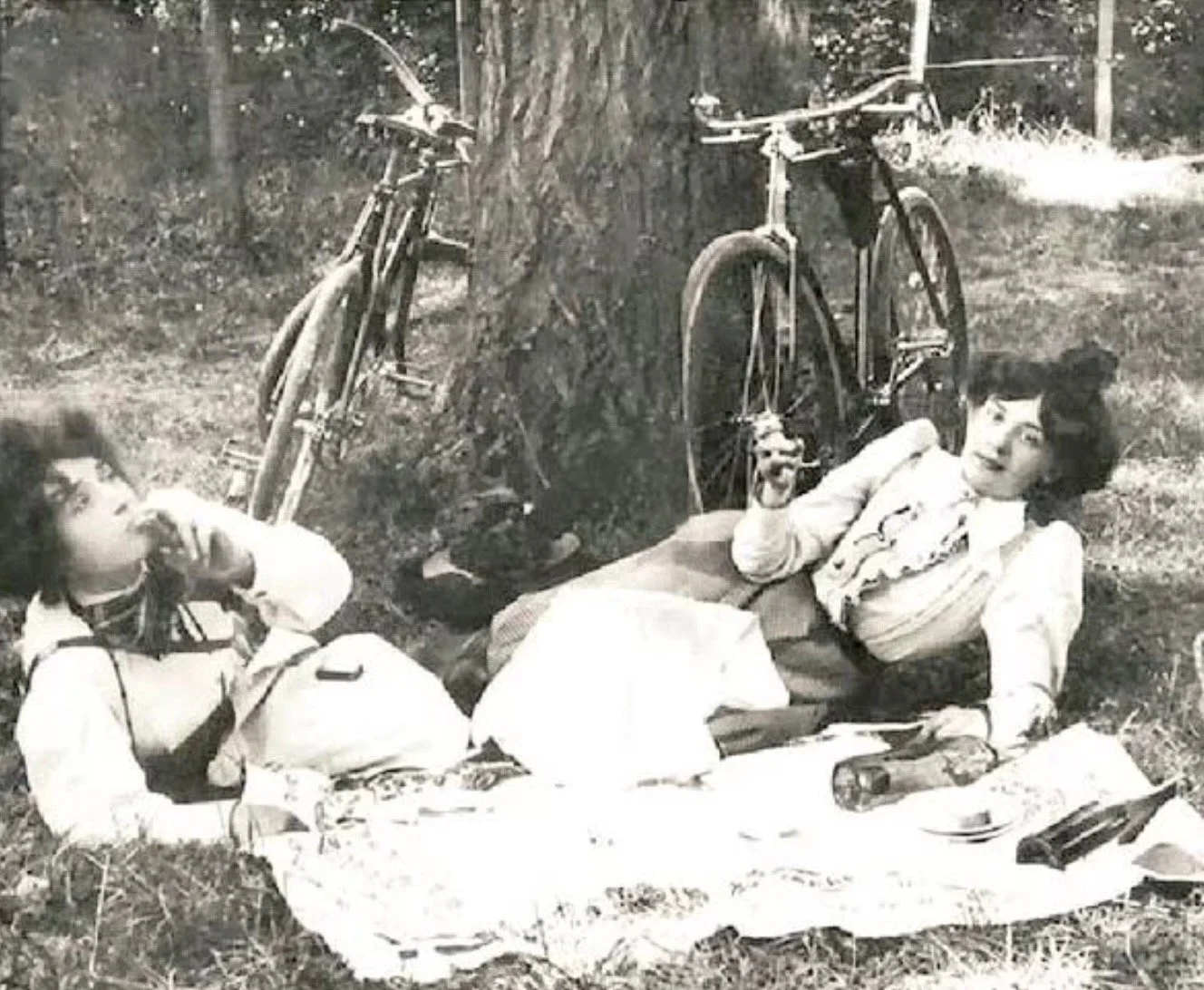
Now that’s my kind of bike ride.
Is re-learning how to ride a two-wheeled bike in midlife just as easy as, well, riding a bike? Juzza gives it a go in France and celebrates the cycling crones who fought for our right to cycle.
Jan 23, 2026 first published on our Substack Tits to the Wind! Sign up on Substack to get essays like these straight to your inbox!
“You have arrived,” announces the po-faced lady from the phone in my back pocket. And arrived I have. This is my first solo adventure on two wheels for 45 years and I am absolutely buzzing. Okay so it was only 4k from our campsite to the Tabac in the next village, but never has an espresso in the sun tasted so good.
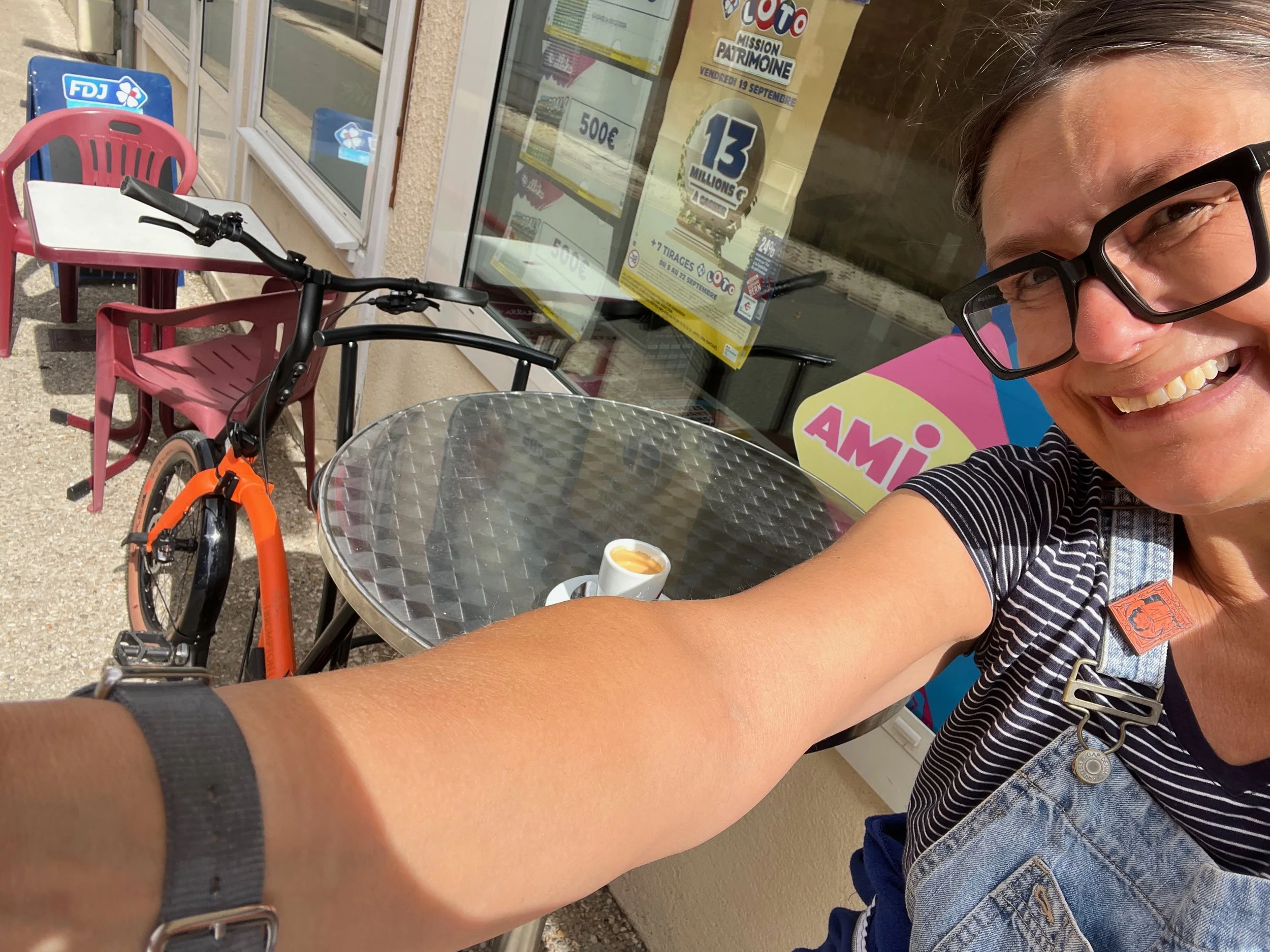
Triumphant at the cafe in ‘Fours’ - my first two-wheeled solo venture since the 1970s.
My first (and last) two-wheeled bike was a Raleigh Chopper in the 1970s. Mine was jet black, with silver decals that shone in the winter sun. And oh, that long, ‘Easy-Rider’ inspired seat, which contrary to the infamous warning label: “This seat is not designed to carry passengers”, was clearly designed to give ‘backies’ to most of the village. I can still remember that rush of freedom as I pushed off for the first time up the road towards the park. Changing gears, just like a real car. That feeling of the open road ahead. Of independence. Of freedom.
(I don’t have any pics of me on my Chopper before it met its grizzly end, but here’s a wonderful picture of a lad playing out on his Chopper on Plantation Avenue in Dinnington around the same time with the pit tip behind. With thanks to Mo Baker and his fabulous Facebook group ‘Pictures of Dinnington old and new.’)
I was proudly polishing my new bike when my brother asked if his mate could borrow it so they could go on a bike ride together. Of course, I would usually have said ‘no’, but it transpired that the lad in question was the one I’d secretly dreamt would one day sit astride my Easy Rider seat behind me, his arms wrapped tightly around my waist 🥰… so how could I refuse?!
Aside from that long seat that lured you into rule breaking, the other fatal design flaw of the Chopper was its small front wheel, which was prone to making the whole bike wobble on steep hills. And so it was that my romantic crush became physically crushed, as both he, and and my beloved Chopper, wiped out on a hill and slid underneath a lorry.
Unlike my bike, incredibly he survived, though was in hospital for several months and carried a scar right across his beautiful face for the rest of his life. Someone told me he ended up in borstal and was never the same again. And I don’t want to sound selfish, but neither was my relationship with cycling. Bikeless, me and my friend had to resort to stealing my brother’s BMX for our eyewatering bike-riding expeditions, baffled as to why BMXs weren’t also compelled to carry warning signs on their saddles:
“This bike is not designed to carry vaginas.”
I know I should feel ashamed for writing that, as our feminist ancestors had such a fight on their hands to get women AND OUR BITS on bikes. The patriarchy - terrified of the freedom that bikes could bring women - peddled some fantastic fear-mongering stories to keep us in our place. From medical claims that cycling would damage our reproductive organs, to the horror of the made up* medical condition of ‘Bicycle Face’, with its ‘bulging eyes and permanent exhaustion’ - clearly a safe bet to a life of spinsterdom. (*I say made up, they’d clearly never been for a long bike ride on their brother’s BMX).
Worst still, as historian, Jennifer Hargreaves, writes in ‘The Victorian Cult of the Family and the Early Years of Female Sport,’ cycling “could even transport women into prostitution.” (Hargreaves, in Gender and Sport, 2001.)
Thank god for the ‘Revolting Daughters’ who pulled up their skirts and did it anyway. Women like Beatrice Ethel Grimshaw (1870–1953) who was an Irish writer, traveller, and proudly self-described ‘troublemaker’. Her first rebellion against Victorian propriety and expectations was to do the worst thing imaginable - buy a bicycle!
“I was The Revolting Daughter – as they called them then. I bought a bicycle, with difficulty. I rode it unchaperoned, miles and miles beyond the limits possible to the soberly trotting horses. The world opened before me. And as soon as my twenty-first birthday dawned, I went away from home, to see what the world might give to daughters who revolted.”[38]
French feminists like Marguerite Durand (1864 – 1936) championed the bicycle as a tool of independence. She was a French stage actress, journalist, and a leading suffragette. (Warning: rabbit hole approaching…) She also founded her own newspaper, ran for election and was known for walking her pet lion around the streets of Paris. Crone AF, n’est pas?
Bicycles did indeed bring unprecedented freedom to some women. They created a change in restrictive clothing, independence of movement and were an iconic symbol of early feminism. As American Social reformer and women’s rights activist, Susan B. Anthony (1820 –1906) stated in 1896:
“Let me tell you what I think of bicycling. I think it has done more to emancipate women than anything else in the world. It gives women a feeling of freedom and self-reliance. I stand and rejoice every time I see a woman ride by on a wheel.”[37]
But, it wasn’t just the feeling of freedom the patriarchy didn’t want us to get a taste of. It was the political threat of women being able to move around their towns and villages, enabling them to spread new ideas and connect with like-minded women.
In this fabulous blog by Historian Sheila Hanlon, she shares a story of the Leicester suffragette, Alice Hawkins, who used the bike to get around Leicester to bring together working class women in the suffrage movement.
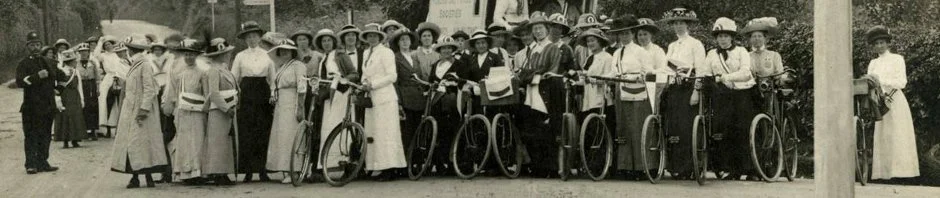
Alice Hawkins founded the Leicester Women’s Suffrage and Political Union (WSPU), and bicycles became essential tools of the trade. According to Richard Whitmore, in Alice Hawkins and the Suffragette Movement in Edwardian Leicester, during the 1911 general election, WSPU cyclists dressed in suffragette colours and rode en masse to Loughborough to distribute pamphlets. One of them, Bertha Clark, later remembered the joy of the ride - how strangers smiled and saluted as they approached, with green, white, and purple ribbons fluttering in the breeze.
While researching this article, I was overjoyed to see that Alice’s influence is still having impact. In 2011, Cycles and Suffragettes was founded in Leicester to encourage women to cycle, explicitly linking today’s riders with this rebellious history. And in 2017, the Laurielorry Theatre Company staged Alice in Her Shoes, a street performance re-enacting suffrage protests, during Leicester’s Inside Out festival.
My perimenopausal cycling urges, some biking barriers, and how I overcame them.
I read somewhere that our FSH levels (Follicle-Stimulating Hormone) in perimenopause, are the same as when we were girls before puberty. This may account for some of the joyfully ‘child-like’ crone traits which emerged in me with primal ferocity when perimenopause came a knocking…
The first was a thirst for sisterhood and the friendship of like-minded women. The second, an uncontrollable urge to throw myself into any body of water - the colder the better…and the third? An inexplicable urge to ride, nay, PLAY OUT, on a bike.
I say ‘inexplicable’ because cycling for a middle-aged woman made no sense to me for the following reasons:
😱 1. Fear of Sheffield Hills. I live in Sheffield which, like Rome, is on seven hills (well, eight before the boundaries were moved, but who’s counting) and I had always been of the opinion that cycling up hills was purely the domain of the insane.
😱 2. Fear of Sheffield traffic and angry drivers - why can’t we all just get along?!
😱 3. What to do with Stan-the-dog? My daily exercise is taking the dog out for walks. Would cycling replace this activity, meaning I’d walk the dog less?
😱 4. What to do with the bike when not using it? I live in a tiny terrace up some very steep steps and don’t have a garage, meaning I wouldn’t be able to get it up the steps or have anywhere to safely store it.
😱 5. And finally, my biggest sticking point of all…Fear of Lycra. Don’t get me wrong, some of my best friends are MAMILs (Middle Aged Men In Lycra), but the very sight of those tight lycra shorts, especially with all that padding, gives me thrush.
Pretty much all my practical barriers to cycling were overcome in one fell swoop, with the incredible gift from my partner of an electric trike for my 50th birthday. I’d been introduced to a trike when visiting Crone Kazza, who didn’t drive but used a trike for her gardening business. Joy of joys, she had not one, but two, and we rode round and round her estate with Stan in the basket, howling with laughter like two kids playing out.
The great thing about trikes is they have room to carry your dog, and also they overcome the feeling of vulnerability when sharing the road with angry car users. This is because trikes are fookin’ MASSIVE! You have NO CHOICE but to take up space on the road, and you feel much more visible too.
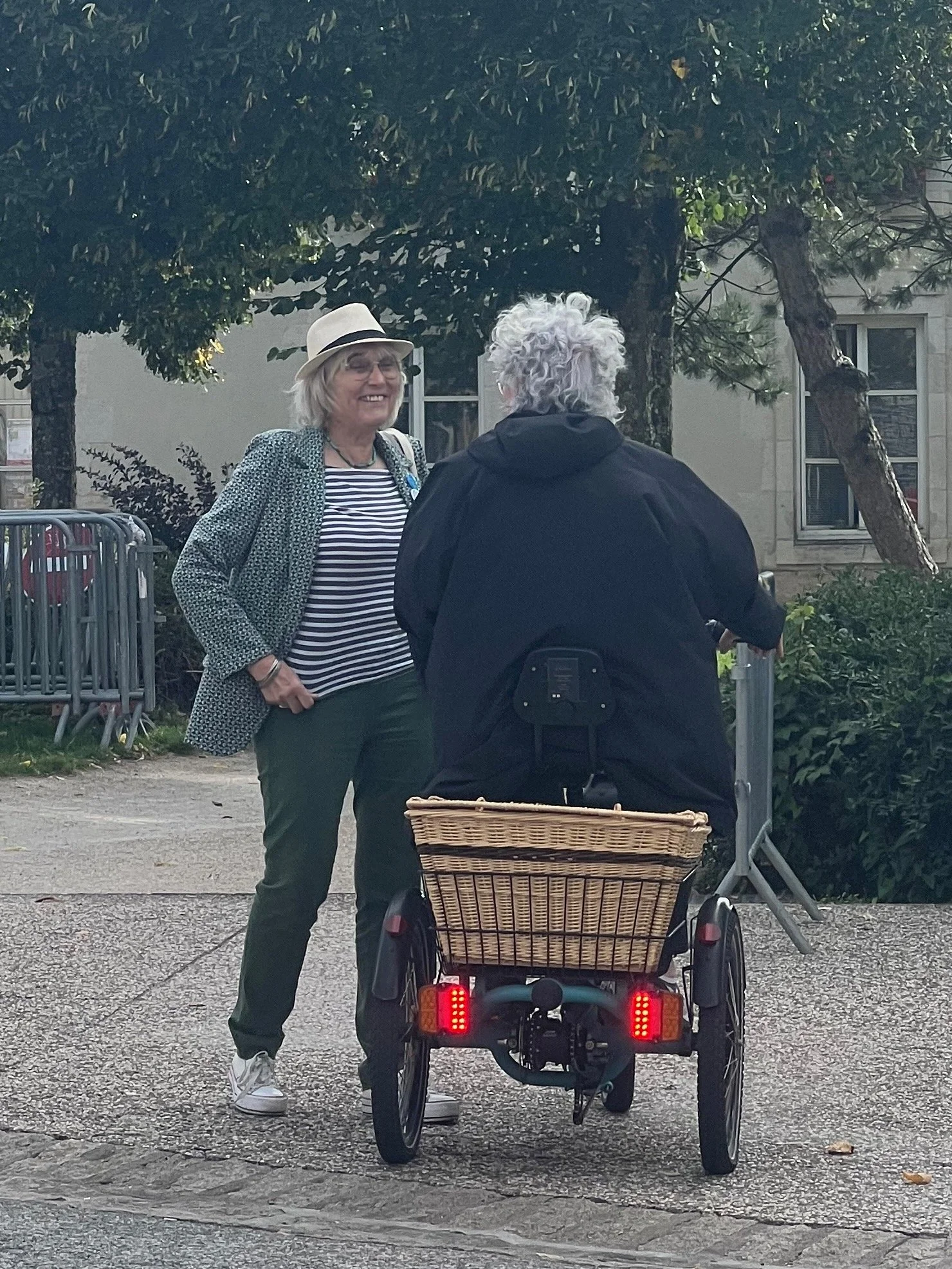
I had to laugh when we were in France and I took this picture of a crone on her trike returning from the Saturday market, unapologetically holding up traffic by stopping for a chat with a fellow crone. Literally holding space. 🇫🇷
And the barrier of the Sheffield hills? Go electric, obvs. Of course the size and weight of an electric trike does create an issue around storage and made getting it up the steps to the house an impossibility. But there’s a solution for most things, and so I traded my car in for an old van to store it in.
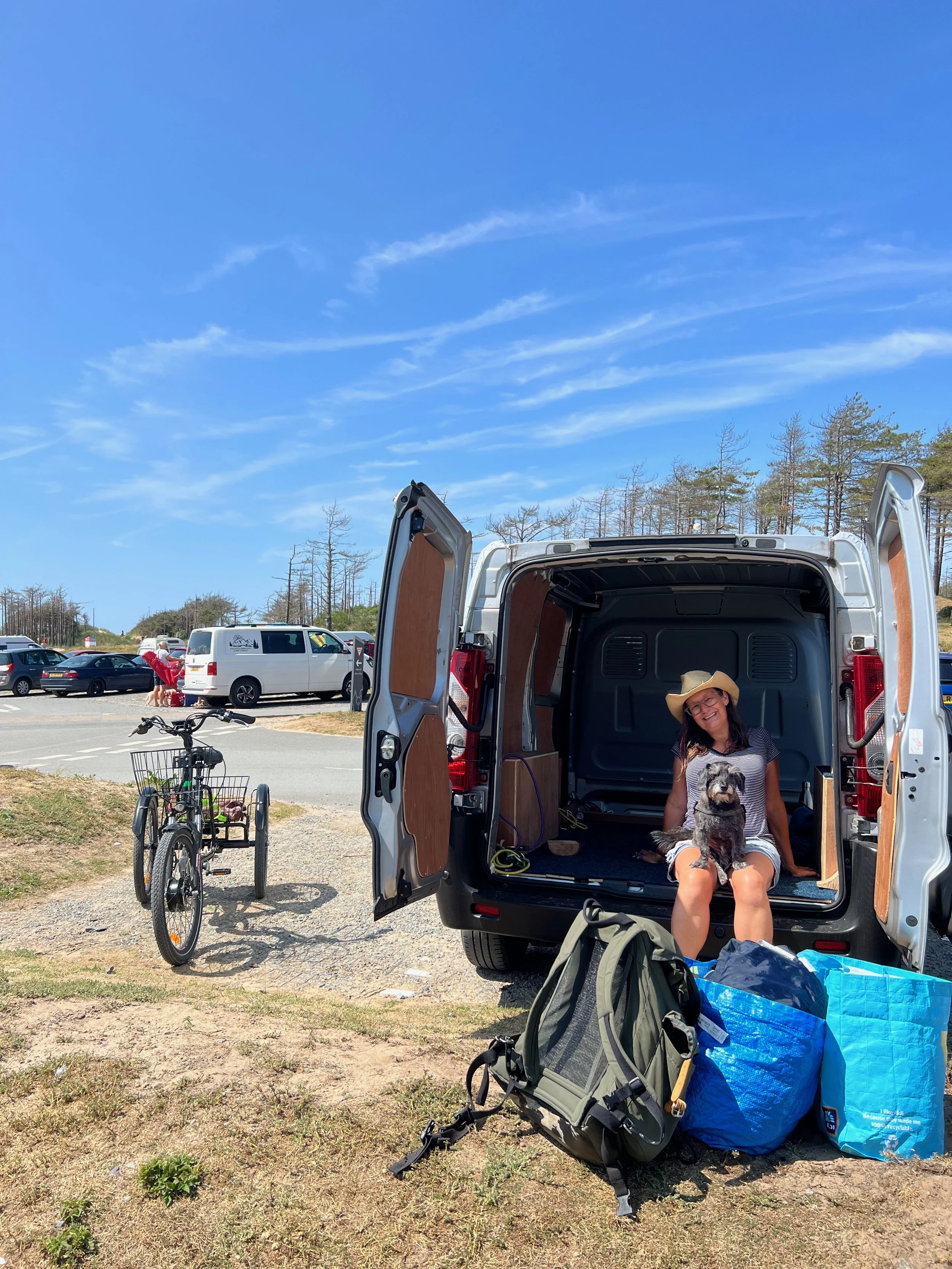
Me, my van, Stan and the trike after a tricycle around Newborough beach in Anglesey.
Overcoming the loathing of lycra thing…Les chic femmes dans leurs bicyclettes.
Cycling and fashion have always been uncomfortable bedfellows since the invention of the bike, which women were, of course, actively discouraged from using.
In 1898, Lady Harberton was refused service at the Hautboy Hotel in Ockham for the radical act of sporting “rational dress” - baggy knickerbockers and a jacket - instead of the ankle-length skirt designed to keep women decorative and constrained.
Cycling UK bravely took the hotel to court, but lost as an all-male jury were (unsurprisingly) unmoved by a woman choosing comfort over convention. But it made headlines, sparked debate, and helped push women’s cycling forward. Fittingly, her name lives on today as a women’s cycling clothing brand, and Cycling UK still backs what she stood for: the right for women to move freely, dress comfortably, and take up space. 👊🏽
It’s ironic then, that it was the modern ‘rational dress’ that was putting me off cycling. It would be going to France that would help me overcome this shamefully shallow aesthetic barrier to cycling.
We are in my friend’s favourite campsite in Épernay, when a crone cycles past us on a black, vintage bike. She is SO stunningly elegant and beautiful, that we both stop and stare.
“Wow, aren’t the French crones chic!” I whisper to Neil, in hushed admiration.
“Yes,” agrees Neil. “But that one was Dutch.”
But the point is, of all the older women on bikes we saw on our two month trip, (whether Dutch or French), there was no lycra in sight, and they all looked cool as fk. Suddenly I could SEE myself on a bike, cycling back with a baguette strapped to the handlebars, stylish and French-chic-as-fk. As the accessibility adage goes, ‘You’ve got to see it to be it.’
Getting back on two wheels and cycling to freedom
On our most recent digital nomad trip, Neil had brought a folding Brompton bike, which he’d use for the baguette run in the morning. I felt a creeping urge to have a go myself, and see if I could get back onto two wheels.
Would it be ‘just like riding a bike’?
My first attempt was around a carpark in the French fort town of Longres, which Neil captured on video for posterity and you can watch below. The massive underwhelming moment as he waits for me to emerge from behind the van still makes me howl. 😂
My second attempt was at the wonderful campsite ‘Crone Utopia’ (which I wrote about here). I got a little braver and decided to ride to the end of the long, windy track. It started raining. I put my orange rain mac on and my dreams of crone-cycle-chic ebbed away, favouring Sweaty-Tango-Orange-Chic instead. But worst of all, I just couldn’t seem to stop the handlebars from wobbling wildly like I was doing a comedy impression of someone trying to crash. Neil and Stan were awaiting my return eagerly, and captured it below. Thankfully, he stops filming before I fling the bike onto the floor shouting: ‘FKING WANK!!’
Turns out getting back on two wheels is NOT ‘just like riding a bike’.
The next day, however, after a successful morning’s writing, I decide today is the day when I’ll give it another go. The sun is out and I long to feel its rays on my back and French terroir beneath my legs.
This time as I push off up the hill, something feels different. The muscle memory from all those years ago seems to have returned, along with that joyous rush of the promise of the open road and riding my bicycle wherever I liked.
Away I go, past the kindly old professor sitting at his table with his Panama hat and his watercolours.
Away I push, past the Dutch crone couple and their loyal golden retriever who wags her tail in encouragement.
Away I pedal, past the older couple with the cut-glass vase of wildflowers sharing a carafe.
Away I travel, past the field with the white cattle lolling on their huge flanks.
Past the buzzard sitting on the post, eyeing me in admiration.
I’m now picking up speed and my eyes are watering, but I resist the urge to clamp the breaks and instead let out a crone primal hoot of delight.
An epic 15 minutes (!) later, I triumphantly reach the village square, filled with the sort of red sand we used to play hockey on, that took your knees off. I can’t see a church, but at that moment, the bells start pealing to welcome me, like it’s been cued by the fat controller on the Truman Show. I spot a cafe on the other side of the square and climb off my bike, propping it against the wall of the Tabac.
It’s cool and dark inside, and it takes a few moments for my eyes to adjust from the bright light outside. Original terracotta tiles line the floor, smoothed by a time when animals probably lived in here too. At the end of the bar, I can just about make out an older man in a beret atop a bar stool, sipping his morning pastis.
The man behind the bar has a huge face and kind eyes. Now I have the confident swagger of a cyclist, I feel I should also have the confidence to be a competent French speaker too. “Un cafe, sil vous plaît,” I say in my best French.
And for the first time on the trip, I’ve had the chest balls to order for myself and I seem to have been understood. There’s no blank stare. No badly hidden irritation at another ‘Rost bif’ mangling their beautiful language.
Instead, he nods and flings his tea towel over his shoulder like Rene in ‘Allo Allo’ and shuffles over to a pile of white utilitarian cups and saucers. He takes a cup and fiddles around with the coffee machine, which explodes into action. He passes it to me. Even in the dimly lit cafe, I can see it has that fabulous golden caramel swirl clinging to the sides.
I take my coffee outside, back into the bright sunshine, and sit at a table looking out over the square. In my head, this article is now starting to take shape, and I slip into a reverie about my Jet Black Raleigh Chopper and wondering what happened to the boy who wrote it off. In my mind, I trace that deep scar across his beautiful face.
The old chap who was propping up the bar now shuffles past me blinking. He nods his head in my direction, his beret at a jaunty angle. “Au revoir, Madame” he says. “Au revoir, Monsieur!” I reply, like a native. But there’s another voice I can also hear, and I realise it’s coming from my back pocket. I pull out my mobile phone which is dripping in sweat. Google Maps is still on, and whilst I’ve been sipping my coffee and daydreaming this article, the po-faced lady has been patiently trying to tell me something important.
“You have arrived,” she announces.
I laugh out loud, “Madame, you have no idea!”
10 Likes∙
Discussion about this post
The Susan B. Anthony quote about bicycles and emancipation is one of thos historical connections that people really dont think about enough. Had no idea about the whole Bicycle Face myth either, the patriarchy really pulled out all the stops. Something about the image of suffragettes on bikes distributing pamphlets is just so rad.
Reply
Share
This story is wonderful, evocative and entertaining. I grew up in a cycling family, my dad was a racing cyclist, president of the Meersbrook cycling club for years. He built our road bikes and I was often marshalling at Sunday races and time trials from being a young teenager. But I was never allowed to play out on my bike, it was too important and I might break something🙁
So I’ve always been a cyclist, until a couple of years ago, when I stopped for reasons of poor family health. But I can recommend a couple of really valuable cycling items for Women….padded pants and ‘Chamois Crème Woman’ to protect our bum bones and our precious genitals😁